
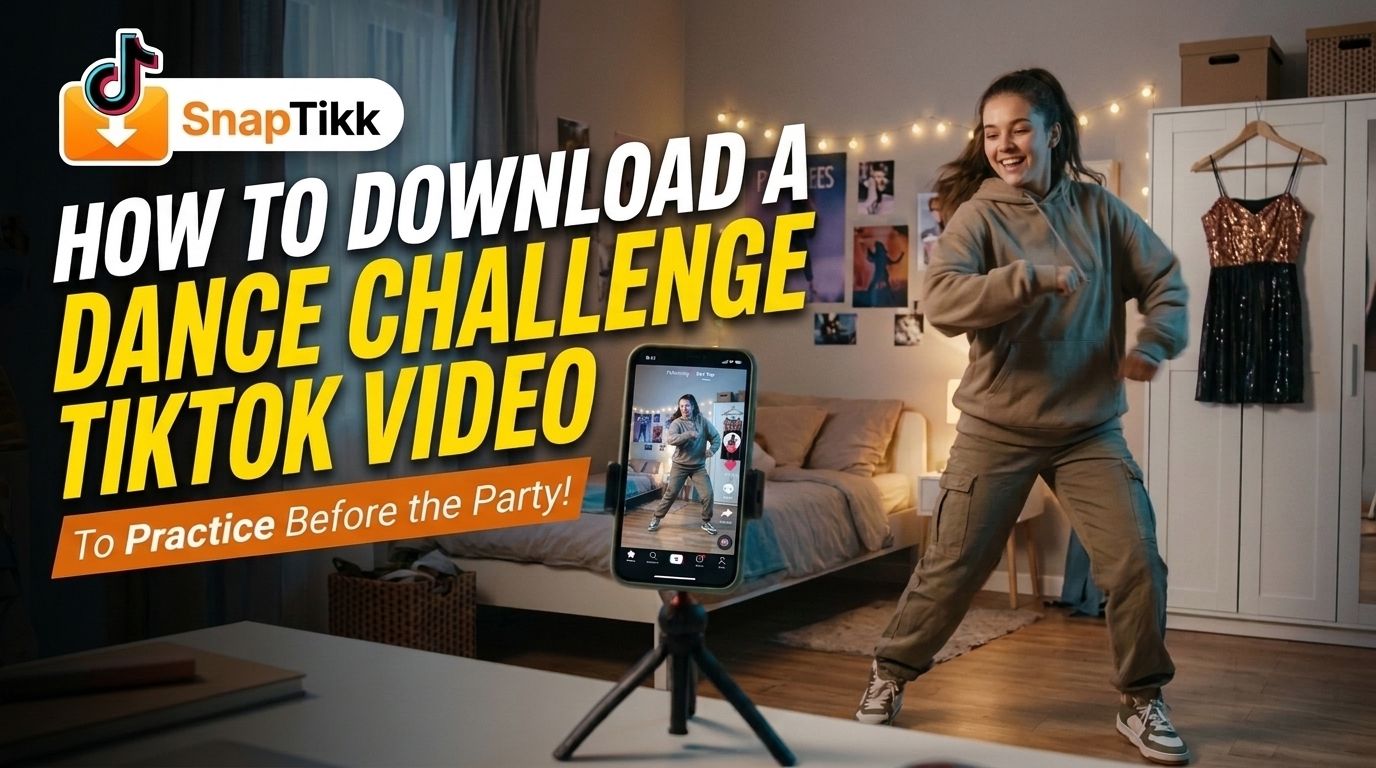
Acquiring a local copy of a dance challenge video from TikTok for offline rehearsal transforms an ephemeral social media stream into a deterministic training asset capable of supporting repetitive motor skill acquisition prior to a live social gathering. Streaming a viral choreography clip directly inside the native mobile application introduces severe operational bottlenecks, including variable bitrate throttling, forced algorithmic feed refreshes upon screen lock, sudden network dropouts inside dead zones, and the inability to scrub individual video frames with millisecond precision. When a dancer prepares for an upcoming party where social execution demands muscle memory, rhythmic synchronization, and spatial awareness, relying on an active cellular or wireless connection creates unacceptable latency between visual observation and physical repetition. Local storage eliminates adaptive streaming degradation, ensuring that every micro movement, weight transfer, and hand gesture remains sharp across dozens of consecutive playback loops without consuming mobile data quotas or triggering battery draining background telemetry processes.
Architectural Realities of TikTok Video Delivery and Watermark Stripping
Understanding how TikTok encodes, stores, and distributes choreography clips clarifies why native download functions often hinder rehearsal quality and why specialized extraction pipelines become necessary. When a creator uploads a dance routine, the platform ingestion servers transcode the raw camera footage into multiple fragmented streams utilizing High Efficiency Video Coding alongside Advanced Audio Coding to balance visual fidelity against global bandwidth constraints. Standard in app saving mechanisms frequently composite an animated overlay containing the creator handle and platform emblem directly onto the pixel grid during export, obscuring crucial footwork or peripheral hand placements near the edges of the frame. Utilizing a dedicated web based utility such as trình tải TikTok sạch logo allows a practitioner to query the underlying content delivery network manifest and retrieve the clean, uncomposited MPEG 4 container directly from the media server. Bypassing the visual watermark layer preserves the full unobstructed viewport, which proves indispensable when analyzing subtle ankle pivots, floor contact angles, and lower body posture during complex choreography sequences.
Resolving Creator Privacy Restrictions and Disabled Native Save Permissions
Many viral dance choreographers intentionally or inadvertently disable the native download toggle within their privacy settings, leaving learners unable to save the reference routine through standard interface menus. This restriction stems from creator account defaults, regional copyright licensing rules governing commercial audio tracks, or automated safety filters applied to newly published videos. Even when the native share sheet omits the save video button, the underlying media asset remains publicly accessible via its unique uniform resource locator because any web browser or mobile client must fetch the video packets to render playback on screen. Copying the canonical share link from the TikTok interface and passing that string into an external parsing engine resolves the direct asset pointer without requiring authenticated session tokens or altering the creator account state. Practitioners should verify that the source video is set to public visibility rather than private or friends only status, as restricted access control lists block external content delivery network nodes from serving the raw video stream to third party resolvers.
Preserving Frame Rate Integrity and Temporal Resolution for Rapid Choreography
Fast paced dance challenges rely heavily on transient kinetic transitions, rapid isolations, and syncopated beats that become completely illegible if the downloaded video suffers from frame rate decimation. Standard social media compression pipelines occasionally drop frames from sixty frames per second down to twenty four or thirty frames per second when serving low bandwidth variants, introducing motion blur during swift arm swings or spinning combinations. Selecting the highest available resolution tier during the extraction process ensures that the saved file retains its native temporal cadence and sharp intra frame detail. High temporal resolution allows the dancer to pause the video mid transition and observe exact joint alignment, shoulder inclination, and center of gravity distribution without guessing through smeared pixel artifacts. Furthermore, maintaining the original bit depth prevents color banding across dark studio backgrounds or monochrome outfits, enabling clear visual separation between the dancer limbs and the surrounding environment during frame by frame inspection.
Navigating Audio Synchronization and Beat Alignment Across Local Media Players
Rhythmic accuracy forms the foundation of any party dance performance, making audio visual synchronization a critical technical requirement when downloading choreography files. During online streaming, network jitter can momentarily desynchronize the audio buffer from the video decoder, creating subtle timing offsets that train incorrect musical cues into the dancer muscle memory. Once the MPEG 4 file resides locally on solid state storage, hardware accelerated media decoders lock the audio sample clock directly to the video presentation timestamps, guaranteeing frame accurate beat alignment across every repetition. Practitioners should verify that the downloaded file retains its original forty four point one or forty eight kilohertz stereo audio stream rather than a heavily compressed mono fallback, as crisp transient percussion hits help identify exact count markers such as the and counts between primary beats. When rehearsing complex syncopated routines, clear high frequency hi hat and snare transients provide essential auditory anchors that coordinate foot strikes with musical phrasing.
Establishing an Offline Rehearsal Environment with Precision Playback Controls
Once the clean video file is stored locally on a smartphone, tablet, or laptop, transferring playback away from basic gallery viewers into a dedicated media player unlocks specialized analytical tools tailored for physical practice. Standard operating system photo viewers typically lack granular speed adjustments, forcing learners to watch rapid choreography at full tempo before mastering foundational body mechanics. Importing the downloaded clip into an advanced local player such as VLC Media Player or specialized dance rehearsal software enables continuous variable speed playback ranging from twenty five percent up to one hundred percent tempo without altering the musical pitch. Pitch preservation algorithms prevent the audio track from dropping into distorted low frequencies during slow motion study, allowing the dancer to hear vocal cues and melodic phrasing clearly while executing movements at half speed. Combining slow motion playback with custom A to B loop markers isolates a difficult four count sequence, repeating those exact seconds seamlessly until physical execution becomes effortless and automatic.
Implementing Horizontal Mirroring to Eliminate Left and Right Cognitive Translation
One of the most persistent cognitive obstacles when learning choreography from a front facing camera recording is the mirror reversal effect, where the onscreen dancer right side corresponds to the viewer left side. Attempting to mentally invert every directional cue in real time consumes working memory and frequently leads to hesitant, backwards execution during a high energy party environment. Because front facing TikTok cameras already capture mirrored footage in some instances while rear facing cameras capture true spatial orientation, downloaded files often present inconsistent directional perspectives. Loading the saved local file into a media player or lightweight video editor that supports real time horizontal flipping allows the practitioner to orient the onscreen performer as if looking into a studio mirror. Practicing against a horizontally mirrored video aligns visual perception directly with bodily kinesthetics, ensuring that stepping toward the right side of the screen translates naturally into stepping toward the right side of the rehearsal room.
Managing Mobile Storage Architecture and Cross Device File Transfers
Preparing for an event often involves compiling multiple trending dance challenges into a structured rehearsal library, which requires deliberate file organization and cross device accessibility. Mobile operating systems route browser downloads into default directories that can become cluttered with unrelated documents, making quick retrieval difficult during focused practice sessions. Creating a dedicated local folder specifically for party choreography keeps reference clips isolated, easily searchable, and safe from automated cache cleaning utilities that purge temporary browser storage. When practicing in a living room or studio space, casting or transferring the downloaded files from a handheld phone to a larger television or laptop screen dramatically improves spatial visibility and posture self correction. Utilizing direct wireless transfer protocols such as AirDrop, Nearby Share, or local network file sharing preserves the exact original file encoding without subjecting the video to the severe recompression penalties imposed by messaging applications like WhatsApp or Messenger.
Troubleshooting Common Extraction Failures and Corrupted Media Containers
Technical anomalies occasionally interrupt the download workflow, resulting in zero byte files, unplayable containers, or missing audio tracks that stall rehearsal preparation. When a download link expires mid transfer due to temporary content delivery network token rotation, refreshing the source TikTok page and generating a fresh share link resolves the authentication timeout immediately. If a saved file plays audio without video or fails to open inside a mobile player, the issue usually stems from an incomplete container header or an unsupported codec profile such as AV1 on older hardware devices. Re initiating the download while selecting a standard H264 encoded MPEG 4 stream guarantees universal hardware decoding compatibility across legacy smartphones, smart televisions, and desktop computers. Additionally, clearing browser cache data or disabling aggressive script blockers prevents interference with the asynchronous network requests that fetch the media manifest, ensuring reliable, repeatable downloads whenever new party dances emerge.
Structuring a Progressive Motor Learning Workflow Using Local Video Assets
Possessing a clean, high frame rate, horizontally mirrored local video file achieves maximum value when paired with a systematic rehearsal methodology leading up to the event date. Begin the learning process by watching the downloaded routine at full speed several times without moving, allowing the brain to map the overarching musical structure, energy shifts, and spatial pathways. Transition into segmented chunking by setting A to B loop boundaries around the opening eight count phrase, reducing playback speed to fifty percent while focusing exclusively on lower body footwork and weight distribution. Once the feet move automatically without visual fixation, layer in torso isolations, arm angles, and head accents while gradually increasing playback speed in ten percent increments until reaching full original tempo. Conducting final dress rehearsals with the audio playing through external speakers while the screen remains out of sight verifies true kinesthetic retention, guaranteeing confident, fluid execution when the track drops on the party dance floor.